Текст документа
Русский текст Конвенции с поправками 1956 года и английское приложение (Schedule) в редакции сентября 2024 года.
МЕЖДУНАРОДНАЯ КОНВЕНЦИЯ
ПО РЕГУЛИРОВАНИЮ КИТОБОЙНОГО ПРОМЫСЛА
(Вашингтон, 2 декабря 1946 года)
Правительства, чьи должным образом уполномоченные представители подписали настоящий документ,
признавая, что народы всего мира заинтересованы в сохранении для будущих поколений тех огромных естественных богатств, которые представляют собой стада китов;
учитывая, что в истории китобойного промысла известны случаи истребления в ряде районов одного вида китов за другим и в такой мере, что возникает необходимость в охране всех видов китов от дальнейшего истребления;
признавая, что при надлежащем регулировании промысла запасы китов будут естественно увеличиваться и что увеличение размеров поголовья позволит добывать большое количество китов без ущерба для естественных ресурсов;
признавая, что в общих интересах необходимо в кратчайший срок довести поголовье китов до наивысшей его численности, не вызывая при этом значительных нарушений ни в экономике, ни в деле питания;
признавая, что в период, в течение которого будет достигнута вышеуказанная цель, необходимо китобойные операции ограничивать только теми видами китов, добыча которых в промышленных масштабах еще возможна, чтобы таким образом выиграть время, необходимое для восстановления численности тех некоторых видов, которые подверглись истреблению;
желая установить систему международного регулирования китобойного промысла и обеспечить надлежащее и эффективное сохранение поголовья китов и его развития на основе принципов, содержащихся в Международном соглашении о регулировании китобойного промысла, подписанном в Лондоне 8 июня 1937 г., и в Протоколах к этому Соглашению, подписанных в Лондоне 24 июня 1938 г. и 26 ноября 1945 г., и,
решив заключить Конвенцию, предусматривающую надлежащее сохранение поголовья китов и обеспечивающую упорядоченное развитие китобойного промысла,
согласились о нижеследующем:
Статья I
1. Настоящая Конвенция имеет приложение, которое составляет с ней одно целое. Все ссылки на Конвенцию распространяются также на названное приложение как в настоящей их формулировке, так и с поправками, предусмотренными в статье V.
2. Эта Конвенция распространяется на китоматки, береговые станции и китобойные суда, находящиеся под юрисдикцией Договаривающихся правительств, и на все воды, в которых оперируют эти китоматки, береговые станции или китобойные суда.
Статья II
Употребляемые в настоящей Конвенции термины:
1. «Китоматка» — означает судно, в котором или на котором полностью или частично перерабатываются китовые туши.
2. «Береговая станция» — означает завод на берегу, частично или полностью перерабатывающий китовые туши.
3. «Китобойное судно» — означает судно, служащее для охоты за китами, для их убоя, буксировки, зачаливания или для разведки китов.
4. «Договаривающееся правительство» — означает любое правительство, которое представило документы о ратификации настоящего Соглашения или заявило о своем присоединении к этой Конвенции.
Статья III
1. Договаривающиеся правительства постановили учредить Международную китобойную комиссию, в дальнейшем называемую «Комиссией», включающую по одному члену от каждого Договаривающегося правительства. Каждый член имеет один голос и располагает одним экспертом или советником или большим числом их.
2. Комиссия избирает из своей среды председателя и вице-председателя и вырабатывает свои правила процедуры.
Решения Комиссии принимаются простым большинством голосов; это не относится к вопросам, предусмотренным в статье V, для решения которых требуется большинство из трех четвертей от числа членов, обладающих правом голоса.
Правила процедуры могут позволить принимать решения не только на заседаниях Комиссии, но и другими путями.
3. Комиссия назначает своего секретаря и штат.
4. Комиссия может выделить из среды своих членов, экспертов или советников таких, каких она сочтет желательными для выполнения функций, на которые она имеет полномочия.
5. Суммы, расходуемые членами Комиссии, экспертами или советниками, определяются и оплачиваются их правительствами.
6. Признавая, что специализированные учреждения, связанные с Организацией Объединенных Наций, также будут заинтересованы в сохранении и развитии китобойного промысла и его продуктов, Договаривающиеся правительства, во избежание параллелизма в работе, в течение двух лет после того, как настоящая Конвенция вступит в силу, будут консультироваться между собой и примут решение по поводу того, следует ли ввести Комиссию в рамки работы одного из специализированных учреждений, связанных с Организацией Объединенных Наций.
7. В то же время Соединенное Королевство Великобритании и Северной Ирландии организует, по совету с другими Договаривающимися правительствами, созыв первого заседания Комиссии и проявит инициативу в деле консультации, упомянутой в параграфе 6.
8. Последующие заседания Комиссии будут созываться по решению Комиссии.
Статья IV
1. Комиссия может через посредство или в сотрудничестве с самостоятельными агентствами Договаривающихся правительств, либо с другими общественными или частными агентствами, учреждениями или организациями, либо самостоятельно:
a) поощрять, рекомендовать и, если необходимо, организовывать изучение и исследование, относящиеся к китам и китобойному промыслу;
b) собирать и анализировать статистическую информацию, касающуюся современных условий существования и перемещения китовых стад, а также влияния промысла на состояние поголовья китов;
c) изучать, давать оценку и распространять сведения, касающиеся методов поддержания и увеличения поголовья китовых стад.
2. Комиссия должна организовать печатание отчетов о своей работе, которые она может публиковать или самостоятельно или в сотрудничестве с Международным статистическим бюро по китобойному промыслу, находящимся в Сандфиорде в Норвегии, или вместе с другими агентствами или организациями доклады, какие она считает необходимыми, а также соответствующие статистические, научные и другие нужные материалы, касающиеся китов и китобойного промысла.
Статья V
1. Комиссия может время от времени вносить поправки к приложению <*> путем принятия правил, относящихся к сохранению и использованию поголовья китов, устанавливая:
<*> Приложение к настоящей Конвенции в Сборнике не помещается, так как оно подвергается ежегодным изменениям.
a) охраняемые и неохраняемые виды китов;
b) открытые и закрытые сезоны;
c) открытые и закрытые воды, включая определение заповедных районов;
d) размеры китов каждого вида, разрешенных к убою;
e) время, методы и интенсивность промысла, включая максимальное количество разрешенных к убою китов, определяемое на каждый сезон;
f) типы и спецификации орудий, аппаратуры и приспособлений, которые могут употребляться;
g) способы измерения и
h) учет количества убитых китов и других статистических и биологических данных.
2. Эти поправки к приложению:
a) должны быть такими, какие необходимы для выполнения целей и задач настоящей Конвенции и для обеспечения сохранения, развития и наилучшего использования китового поголовья;
b) должны основываться на научных открытиях;
c) не должны приводить к ограничению количества или национальной принадлежности китоматок или береговых станций или назначать особые квоты для какой-нибудь китоматки или береговой станции или группы китоматок или береговых станций;
d) должны принимать во внимание интересы китобойного промысла и потребителей его продукции.
3. Каждая из подобных поправок вступит в силу в отношении Договаривающихся правительств спустя 90 дней после того, как Комиссия сообщит об этой поправке каждому из Договаривающихся правительств, исключая случаи:
a) если какое-либо правительство представит Комиссии возражения против какой-либо поправки до истечения 90 дней, то такая поправка будет оставаться недействительной для всех Договаривающихся правительств в течение дополнительного срока в 90 дней;
b) в связи с этим любое другое Договаривающееся правительство может представить возражение против этой поправки в любое время до истечения этого дополнительного срока в 90 дней или до истечения 30 дней со дня получения последнего возражения, присланного в течение этого дополнительного девяностодневного срока независимо от того, какая дата будет последней;
c) после этого поправка вступает в силу для всех Договаривающихся правительств, которые не представили возражений, но не будет действительной для любого правительства, представившего возражение, до того момента, пока оно не будет взято обратно. Комиссия должна известить каждое Договаривающееся правительство немедленно по получении каждого возражения или отклонения, а каждое Договаривающееся правительство должно подтвердить получение всех сообщений о поправках, возражениях или отклонениях возражений.
4. Никакие поправки не будут действительны до 1-го июля 1949 года.
Статья VI
Комиссия может время от времени делать рекомендации одному или всем Договаривающимся правительствам по любому вопросу, касающемуся китов или китобойного промысла или целей и задач настоящей Конвенции.
Статья VII
Договаривающиеся правительства должны обеспечить срочную пересылку Международному статистическому бюро по китобойному промыслу в Сандфиорд в Норвегии или какой-либо другой организации, указанной Комиссией, всех сообщений, статистических или других информаций, оговоренных настоящей Конвенцией, и в такой форме, в какой это будет предложено Комиссией.
Статья VIII
1. Независимо от содержания настоящей Конвенции любое Договаривающееся правительство может выдать своим подданным особое разрешение на промысел, убой и обработку китов для научно — исследовательских целей, подлежащее таким ограничениям в отношении числа и других условий, какие Договаривающееся правительство найдет нужным установить. Промысел, убой и обработка китов, добываемых в соответствии с этой статьей, не подлежат действию настоящей Конвенции. Каждое Договаривающееся правительство должно немедленно сообщать Комиссии обо всех выданных особых разрешениях. Каждое Договаривающееся правительство может в любое время отменить выданное им особое разрешение.
2. Киты, убитые по такому специальному разрешению, должны быть обработаны, насколько это практически возможно, и все операции должны быть выполнены в соответствии с директивами правительства, выдавшего разрешение.
3. Каждое Договаривающееся правительство должно пересылать в организацию, назначенную Комиссией, по мере возможности и с промежутками не больше года все научные сведения, полученные правительством, относительно китов или китобойного промысла, включая результаты исследований, проведенных в соответствии с параграфом 1 этой статьи и статьи IV.
4. Признавая, что непрерывное накопление и анализ биологических данных, связанных с работой китоматок и береговых станций, являются совершенно обязательными для правильного и целесообразного руководства китобойными промыслами, Договаривающиеся правительства должны принять все возможные меры для получения этих данных.
Статья IX
1. Каждое Договаривающееся правительство должно принять соответствующие меры, обеспечивающие применение условий настоящей Конвенции и предусматривающие наказания за нарушение этих условий во время операций, проводимых лицами или судами, находящимися под юрисдикцией этого Договаривающегося правительства.
2. Никакие премии или другая добавочная оплата не должна производиться гарпунерам и командам китобойных судов за убой китов, охраняемых запретами настоящей Конвенции.
3. Преследование за нарушение настоящей Конвенции или за проступки против нее должно быть организовано правительством, юрисдикции которого подлежит данный проступок.
4. Каждое Договаривающееся правительство должно пересылать в Комиссию подробное сообщение о каждом нарушении пунктов Конвенции лицами или судами, находящимися под юрисдикцией данного правительства в точном соответствии с донесениями его инспекторов. Это сообщение должно включать сведения о мерах, принятых в связи с этим нарушением, и о наложенных взысканиях.
Статья X
1. Настоящая Конвенция должна быть ратифицирована, и документы о ратификации должны быть сданы на хранение Правительству Соединенных Штатов Америки.
2. Любое правительство, не участвовавшее в подписании Конвенции, может присоединиться к ней после того, как она вступит в силу, путем письменного извещения Правительству Соединенных Штатов Америки.
3. Правительство Соединенных Штатов Америки должно известить все правительства, участвующие в Конвенции, а также все правительства, присоединившиеся к Конвенции, обо всех сданных ратификационных грамотах и полученных извещениях о присоединении.
4. Когда будут получены ратификации не менее чем от шести подписавших правительств, в число которых должны войти Правительства Нидерландов, Норвегии, Союза Советских Социалистических Республик, Соединенного Королевства Великобритании и Северной Ирландии и Соединенных Штатов Америки, настоящая Конвенция вступит в силу для этих правительств. Для любого правительства, которое впоследствии ратифицирует Конвенцию и присоединится к ней, она вступит в силу в день сдачи на хранение ратификационных грамот или получения сообщения о присоединении.
5. Правила приложения не будут действительны до 1 июля 1948 г. Поправки к приложению, принятые в соответствии со статьей 5-й, не будут действительны до 1 июля 1949 года.
Статья XI
Любое Договаривающееся правительство может отказаться от настоящей Конвенции 30 июня любого года путем подачи заявления не позднее 1 января того же года правительству, у которого хранятся документы о ратификации и которое по получении подобного заявления должно срочно известить остальные Договаривающиеся правительства. Любое другое Договаривающееся правительство может таким же образом в течение одного месяца после получения копии подобного заявления от правительства, хранящего документы, послать заявление об отказе участвовать в Конвенции так, чтобы последняя перестала распространяться на правительство, приславшее заявление, с 30 июня того же года.
Настоящая Конвенция будет помечена датой, в которую она была открыта для подписания, и останется открытой для подписания в течение последующих четырнадцати дней.
В подтверждение вышеизложенного нижеподписавшиеся, должным образом уполномоченные, подписали настоящую Конвенцию.
Совершено в Вашингтоне 2-го декабря 1946 года на английском языке. Оригинал будет храниться в архивах Правительства Соединенных Штатов Америки. Правительство Соединенных Штатов Америки должно переслать заверенные копии всем Договаривающимся правительствам, а также правительствам, присоединяющимся к Конвенции.
(Подписи)
Приложение к Конвенции (Schedule)
Английский текст приложения в редакции 69-го заседания Комиссии, сентябрь 2024 года.
I. INTERPRETATION
1. The following expressions have the meanings respectively assigned to them, that is to say:
A. Baleen whales
“baleen whale” means any whale which has baleen or whale bone in the mouth, i.e. any whale other than a toothed whale. “blue whale” (Balaenoptera musculus) means any whale known as blue whale, Sibbald’s rorqual, or sulphur bottom, and including pygmy blue whale. “bowhead whale” (Balaena mysticetus) means any whale known as bowhead, Arctic right whale, great polar whale, Greenland right whale, Greenland whale. “Bryde’s whale” (Balaenoptera edeni, B. brydei) means any whale known as Bryde’s whale. “fin whale” (Balaenoptera physalus) means any whale known as common finback, common rorqual, fin whale, herring whale, or true fin whale. “gray whale” (Eschrichtius robustus) means any whale known as gray whale, California gray, devil fish, hard head, mussel digger, gray back, or rip sack. “humpback whale” (Megaptera novaeangliae) means any whale known as bunch, humpback, humpback whale, humpbacked whale, hump whale or hunchbacked whale. “minke whale” (Balaenoptera acutorostrata, B. bonaerensis) means any whale known as lesser rorqual, little piked whale, minke whale, pike-headed whale or sharp headed finner. “pygmy right whale” (Caperea marginata) means any whale known as southern pygmy right whale or pygmy right whale. “right whale” (Eubalaena glacialis, E. australis) means any whale known as Atlantic right whale, Arctic right whale, Biscayan right whale, Nordkaper, North Atlantic right whale, North Cape whale, Pacific right whale, or southern right whale. “sei whale” (Balaenoptera borealis) means any whale known as sei whale, Rudolphi’s rorqual, pollack whale, or coalfish whale.
B. Toothed whales
“toothed whale” means any whale which has teeth in the jaws. “beaked whale” means any whale belonging to the genus Mesoplodon, or any whale known as Cuvier’s beaked whale (Ziphius cavirostris), or Shepherd’s beaked whale (Tasmacetus shepherdi). “bottlenose whale” means any whale known as Baird’s beaked whale (Berardius bairdii), Arnoux’s whale (Berardius arnuxii), southern bottlenose whale (Hyperoodon planifrons), or northern bottlenose whale (Hyperoodon ampullatus). “killer whale” (Orcinus orca) means any whale known as killer whale or orca. “pilot whale” means any whale known as long-finned pilot whale (Globicephala melaena) or short-finned pilot whale (G. macrorhynchus). “sperm whale” (Physeter macrocephalus) means any whale known as sperm whale, spermacet whale, cachalot or pot whale.
C. General
“strike” means to penetrate with a weapon used for whaling. “land” means to retrieve to a factory ship, land station, or other place where a whale can be treated. “take” means to flag, buoy or make fast to a whale catcher. “lose” means to either strike or take but not to land. “dauhval” means any unclaimed dead whale found floating. “lactating whale” means (a) with respect to baleen whales — a female which has any milk present in a mammary gland,
(b) with respect to sperm whales — a female which has milk present in a mammary gland the maximum thickness (depth) of which is 10cm or more. This measurement shall be at the mid ventral point of the mammary gland perpendicular to the body axis, and shall be logged to the nearest centimetre; that is to say, any gland between 9.5cm and 10.5cm shall be logged as 10cm. The measurement of any gland which falls on an exact 0.5 centimetre shall be logged at the next 0.5 centimetre, e.g. 10.5cm shall be logged as 11.0cm.
However, notwithstanding these criteria, a whale shall not be considered a lactating whale if scientific (histological or other biological) evidence is presented to the appropriate national authority establishing that the whale could not at that point in its physical cycle have had a calf dependent on it for milk. “small-type whaling” means catching operations using powered vessels with mounted harpoon guns hunting exclusively for minke, bottlenose, beaked, pilot or killer whales.
II. SEASONS
Factory Ship Operations
2. (a) It is forbidden to use a factory ship or whale catcher attached thereto for the purpose of taking or treating baleen whales except minke whales, in any waters south of 40° South Latitude except during the period from 12th December to 7th April following, both days inclusive.
(b) It is forbidden to use a factory ship or whale catcher attached thereto for the purpose of taking or treating sperm or minke whales, except as permitted by the Contracting Governments in accordance with sub-paragraphs (c) and (d) of this paragraph, and paragraph 5.
(c) Each Contracting Government shall declare for all factory ships and whale catchers attached thereto under its jurisdiction, an open season or seasons not to exceed eight months out of any period of twelve months during which the taking or killing of sperm whales by whale catchers may be permitted; provided that a separate open season may be declared for each factory ship and the whale catchers attached thereto.
(d) Each Contracting Government shall declare for all factory ships and whale catchers attached thereto under its jurisdiction one continuous open season not to exceed six months out of any period of twelve months during which the taking or killing of minke whales by the whale catchers may be permitted provided that:
(1) a separate open season may be declared for each factory ship and the whale catchers attached thereto;
(2) the open season need not necessarily include the whole or any part of the period declared for other baleen whales pursuant to sub- paragraph (a) of this paragraph.
3. It is forbidden to use a factory ship which has been used during a season in any waters south of 40° South Latitude for the purpose of treating baleen whales, except minke whales, in any other area except the North Pacific Ocean and its dependent waters north of the Equator for the same purpose within a period of one year from the termination of that season; provided that catch limits in the North Pacific Ocean and dependent waters are established as provided in paragraphs 12 and 16 of this Schedule and provided that this paragraph shall not apply to a ship which has been used during the season solely for freezing or salting the meat and entrails of whales intended for human food or feeding animals.
Land Station Operations
4. (a) It is forbidden to use a whale catcher attached to a land station for the purpose of killing or attempting to kill baleen and sperm whales except as permitted by the Contracting Government in accordance with sub-paragraphs (b), (c) and (d) of this paragraph.
(b) Each Contracting Government shall declare for all land stations under its jurisdiction, and whale catchers attached to such land stations, one open season during which the taking or killing of baleen whales, except minke whales, by the whale catchers shall be permitted. Such open season shall be for a period of not more than six consecutive months in any period of twelve months and shall apply to all land stations under the jurisdiction of the Contracting Government; provided that a separate open season may be declared for any land station used for the taking or treating of baleen whales, except minke whales, which is more than 1,000 miles from the nearest land station used for the taking or treating of baleen whales, except minke whales, under the jurisdiction of the same Contracting Government.
(c) Each Contracting Government shall declare for all land stations under its jurisdiction and for whale catchers attached to such land stations, one open season not to exceed eight continuous months in any one period of twelve months, during which the taking or killing of sperm whales by the whale catchers shall be permitted; provided that a separate open season may be declared for any land station used for the taking or treating of sperm whales which is more than 1,000 miles from the nearest land station used for the taking or treating of sperm whales under the jurisdiction of the same Contracting Government.
(d) Each Contracting Government shall declare for all land stations under its jurisdiction and for whale catchers attached to such land stations one open season not to exceed six continuous months in any period of twelve months during which the taking or killing of minke whales by the whale catchers shall be permitted (such period not being necessarily concurrent with the period declared for other baleen whales, as provided for in sub- paragraph (b) of this paragraph); provided that a separate open season may be declared for any land station used for the taking or treating of minke whales which is more than 1,000 miles from the nearest land station used for the taking or treating of minke whales under the jurisdiction of the same Contracting Government. Except that a separate open season may be declared for any land station used for the taking or treating of minke whales which is located in an area having oceanographic conditions clearly distinguishable from those of the area in which are located the other land stations used for the taking or treating of minke whales under the jurisdiction of the same Contracting Government; but the declaration of a separate open season by virtue of the provisions of this sub-paragraph shall not cause thereby the period of time covering the open seasons declared by the same Contracting Government to exceed nine continuous months of any twelve months.
(e) The prohibitions contained in this paragraph shall apply to all land stations as defined in Article II of the Whaling Convention of 1946.
Other Operations
5. Each Contracting Government shall declare for all whale catchers under its jurisdiction not operating in conjunction with a factory ship or land station one continuous open seasons not to exceed six months out of any period of twelve months during which the taking or killing of minke whales by such whale catchers may be permitted. Notwithstanding this paragraph one continuous open season not to exceed nine months may be implemented so far as Greenland is concerned. This paragraph shall not apply to aboriginal subsistence whaling under paragraphs 13(b)(3)(ii) and 13(b)(3)(iii).
III. CAPTURE
6. The killing for commercial purposes of whales, except minke whales using the cold grenade harpoon shall be forbidden from the beginning of the 1980/81 pelagic and 1981 coastal seasons. The killing for commercial purposes of minke whales using the cold grenade harpoon shall be forbidden from the beginning of the 1982/83 pelagic and the 1983 coastal seasons.*
7. (a) In accordance with Article V(1)(c) of the Convention, commercial whaling, whether by pelagic operations or from land stations, is prohibited in a region designated as the Indian Ocean Sanctuary. This comprises the waters of the Northern Hemisphere from the coast of Africa to 100°E, including the Red and Arabian Seas and the Gulf of Oman; and the waters of the Southern Hemisphere in the sector from 20°E to 130°E, with the Southern boundary set at 55°S. This prohibition applies irrespective of such catch limits for baleen or toothed whales as may from time to time be determined by the Commission. This prohibition shall be reviewed by the Commission at its Annual Meeting in 2002.☼
(b) In accordance with Article V(1)(c) of the Con- vention, commercial whaling, whether by pelagic operations or from land stations, is prohibited in a region designated as the Southern Ocean Sanctuary. This Sanctuary comprises the waters of the Southern Hemisphere southwards of the following line: starting from 40 degrees S, 50 degrees W; thence due east to 20 degrees E; thence due south to 55 degrees S; thence due east to 130 degrees E; thence due north to 40 degrees S; thence due east to 130 degrees W; thence due south to 60 degrees S; thence due east to 50 degrees W; thence due north to the point of beginning. This prohibition applies irrespective of the conservation status of baleen and toothed whale stocks in this Sanctuary, as may from time
*The Governments of Brazil, Iceland, Japan, Norway and the Union of Soviet 6 within the prescribed period. For all other Contracting Governments this on 9 July 1985 and Brazil on 8 January 1992. Iceland withdrew from the Conv Federation not having been withdrawn, this sentence is not binding upon thes ☼At its 54th Annual Meeting in 2002, the Commission agreed to continue this pr be reviewed again. **The Government of Japan lodged an objection within the prescribed period to The Government of the Russian Federation also lodged an objection to paragr all Contracting Governments except Japan paragraph 7(b) came into force on 6 +Paragraph 7(b) contains a provision for review of the Southern Ocean Sanctu
(1994) Annual Meeting. The first review was completed in 2004, and the secon
to time be determined by the Commission. However, this prohibition shall be reviewed ten years after its initial adoption and at succeeding ten year intervals, and could be revised at such times by the Commission. Nothing in this sub-paragraph is intended to prejudice the special legal and political status of Antarctica.**+
Area Limits for Factory Ships
8. It is forbidden to use a factory ship or whale catcher attached thereto, for the purpose of taking or treating baleen whales, except minke whales, in any of the following areas:
(a) in the waters north of 66°N, except that from 150°E eastwards as far as 140°W, the taking or killing of baleen whales by a factory ship or whale catcher shall be permitted between 66°N and 72°N;
(b) in the Atlantic Ocean and its dependent waters north of 40°S;
(c) in the Pacific Ocean and its dependent waters east of 150°W between 40°S and 35°N;
(d) in the Pacific Ocean and its dependent waters west of 150°W between 40°S and 20°N;
(e) in the Indian Ocean and its dependent waters north of 40°S.
Classification of Areas and Divisions
9. (a) Classification of Areas Areas relating to Southern Hemisphere baleen whales except Bryde’s whales are those waters between the ice-edge and the Equator and between the meridians of longitude listed in Table 1.
(b) Classification of Divisions Divisions relating to Southern Hemisphere sperm whales are those waters between the ice-edge and the Equator and between the meridians of longitude listed in Table 3.
(c) Geographical boundaries in the North Atlantic The geographical boundaries for the fin, minke and sei whale stocks in the North Atlantic are:
FIN WHALE STOCKS
NOVA SCOTIA
South and West of a line through:
47°N 54°W, 46°N 54°30’W,
46°N 42°W, 20°N 42°W.
NEWFOUNDLAND-LABRADOR
West of a line through:
75°N 73°30’W, 69°N 59°W, 61°N 59°W,
52°20’N 42°W, 46°N 42°W and North of a line through:
46°N 42°W, 46°N 54°30’W, 47°N 54°W.
WEST GREENLAND
East of a line through:
75°N 73°30’W, 69°N 59°W,
61°N 59°W, 52°20’N 42°W,
and West of a line through
52°20’N 42°W, 59°N 42°W,
59°N 44°W, Kap Farvel.
ocialist Republics lodged objections to the second sentence of paragraph ntence came into force on 8 March 1982. Norway withdrew its objection ion with effect from 30 June 1992. The objections of Japan and the Russian overnments. ibition but did not discuss whether or not it should set a time when it should
aragraph 7(b) to the extent that it applies to the Antarctic minke whale stocks. h 7(b) within the prescribed period but withdrew it on 26 October 1994. For ecember 1994. y “ten years after its initial adoption”. Paragraph 7(b) was adopted at the 46th in 2016.
EAST GREENLAND-ICELAND
East of a line through: Kap Farvel (South Greenland),
59°N 44°W, 59°N 42°W, 20°N 42°W,
and West of a line through:
20°N 18°W, 60°N 18°W, 68°N 3°E,
74°N 3°E, and South of 74°N.
NORTH NORWAY
North and East of a line through:
74°N 22°W, 74°N 3°E, 68°N 3°E,
67°N 0°, 67°N 14°E.
WEST NORWAY-FAROE ISLANDS
South of a line through:
67°N 14°E, 67°N 0°, 60°N 18°W,
and North of a line through: 61°N 16°W, 61°N 0°, Thyborøn (Western entrance to Limfjorden, Denmark).
SPAIN-PORTUGAL-BRITISH ISLES
South of a line through: Thyborøn (Denmark), 61°N 0°, 61°N 16°W, and East of a line through:
63°N 11°W, 60°N 18°W, 22°N 18°W.
MINKE WHALE STOCKS
CANADIAN EAST COAST
West of a line through:
75°N 73°30’W, 69°N 59°W, 61°N 59°W,
52°20’N 42°W, 20°N 42°W.
CENTRAL
East of a line through: Kap Farvel (South Greenland),
59°N 44°W, 59°N 42°W, 20°N 42°W,
and West of a line through:
20°N 18°W, 60°N 18°W, 68°N 3°E,
74°N 3°E, and South of 74°N.
WEST GREENLAND
East of a line through:
75°N 73°30’W, 69°N 59°W, 61°N 59°W,
52°20’N 42°W, and West of a line through:
52°20’N 42°W, 59°N 42°W,
59°N 44°W, Kap Farvel.
NORTHEASTERN
East of a line through:
20°N 18°W, 60°N 18°W, 68°N 3°E, 74°N 3°E,
and North of a line through:
74°N 3°E, 74°N 22°W.
SEI WHALE STOCKS
NOVA SCOTIA
South and West of a line through:
47°N 54°W, 46°N 54°30’W, 46°N 42°W,
20°N 42°W.
ICELAND-DENMARK STRAIT
East of a line through: Kap Farvel (South Greenland),
59°N 44°W, 59°N 42°W, 20°N 42°W,
and West of a line through:
20°N 18°W, 60°N 18°W, 68°N 3°E,
74°N 3°E, and South of 74°N.
EASTERN
East of a line through:
20°N 18°W, 60°N 18°W, 68°N 3°E, 74°N 3°E,
and North of a line through:
74°N 3°E, 74°N 22°W.
(d) Geographical boundaries in the North Pacific The geographical boundaries for the sperm, Bryde’s and minke whale stocks in the North Pacific are:
SPERM WHALE STOCKS
WESTERN DIVISION
West of a line from the ice-edge south along the 180° meridian of longitude to 180°, 50°N, then east along the 50°N parallel of latitude to 160°W, 50°N, then south along the 160°W meridian of longitude to 160°W, 40°N, then east along the 40°N parallel of latitude to 150°W, 40°N, then south along the 150°W meridian of longitude to the Equator.
EASTERN DIVISION
East of the line described above.
BRYDE’S WHALE STOCKS
EAST CHINA SEA
West of the Ryukyu Island chain.
EASTERN
East of 160°W (excluding the Peruvian stock area).
WESTERN
West of 160°W (excluding the East China Sea stock area).
MINKE WHALE STOCKS
SEA OF JAPAN-YELLOW SEA-EAST CHINA SEA
West of a line through the Philippine Islands, Taiwan, Ryukyu Islands, Kyushu, Honshu, Hokkaido and Sakhalin Island, north of the Equator.
OKHOTSK SEA-WEST PACIFIC
East of the Sea of Japan-Yellow Sea- East China Sea stock and west of 180°, north of the Equator.
REMAINDER
East of the Okhotsk Sea-West Pacific stock, north of the Equator.
(e) Geographical boundaries for Bryde’s whale stocks in the Southern Hemisphere
SOUTHERN INDIAN OCEAN
20°E to 130°E, South of the Equator.
SOLOMON ISLANDS
150°E to 170°E, 20°S to the Equator.
PERUVIAN
110°W to the South American coast, 10°S to 10°N.
EASTERN SOUTH PACIFIC
150°W to 70°W, South of the Equator (excluding the Peruvian stock area).
WESTERN SOUTH PACIFIC
130°E to 150°W, South of the Equator (excluding the Solomon Islands stock area).
SOUTH ATLANTIC
70°W to 20°E, South of the Equator (excluding the South African inshore stock area).
SOUTH AFRICAN INSHORE
South African coast west of 27°E and out to the 200 metre isobath.
Classification of Stocks
10. All stocks of whales shall be classified in one of three categories according to the advice of the Scientific Committee as follows:
(a) A Sustained Management Stock (SMS) is a stock which is not more than 10 per cent of Maximum Sustainable Yield (hereinafter referred to as MSY) stock level below MSY stock level, and not more than 20 per cent above that level; MSY being determined on the basis of the number of whales. When a stock has remained at a stable level for a considerable period under a regime of approximately constant catches, it shall be classified as a Sustained Management Stock in the absence of any positive evidence that it should be otherwise classified. Commercial whaling shall be permitted on Sustained Management Stocks according to the advice of the Scientific Committee. These stocks are listed in Tables 1, 2 and 3 of this Schedule. For stocks at or above the MSY stock level, the permitted catch shall not exceed 90 per cent of the MSY. For stocks between the MSY stock level and 10 per cent below that level, the permitted catch shall not exceed the number of whales obtained by taking 90 per cent of the MSY and reducing that number by 10 per cent for every 1 per cent by which the stock falls short of the MSY stock level.
(b) An Initial Management Stock (IMS) is a stock more than 20 per cent of MSY stock level above MSY stock level. Commercial whaling shall be permitted on Initial Management Stocks according to the advice of the Scientific Committee as to measures necessary to bring the stocks to the MSY stock level and then optimum level in an efficient manner and without risk of reducing them below
*The Governments of Japan, Norway, Peru and the Union of Soviet Socialist R all other Contracting Governments this paragraph came into force on 3 Februar withdrew its objections with effect from 1 May 1987 with respect to commer whaling for minke and Bryde’s whales; and from 1 April 1988 with respect to Federation not having been withdrawn, the paragraph is not binding upon these •Iceland’s instrument of adherence to the International Convention for the Reg 2002 states that Iceland ‘adheres to the aforesaid Convention and Protocol wit Convention’. The instrument further states the following:
‘Notwithstanding this, the Government of Iceland will not authorise whal will not authorise such whaling while progress is being made in negotiati so-called moratorium on whaling for commercial purposes, contained in p the completion of the RMS. Under no circumstances will whaling for comm management and enforcement scheme.’
#The Governments of Argentina, Australia, Brazil, Chile, Finland, France, Germ Spain, Sweden, UK and the USA have lodged objections to Iceland’s reservatio
this level. The permitted catch for such stocks will not be more than 90 per cent of MSY as far as this is known, or, where it will be more appropriate, catching effort shall be limited to that which will take 90 per cent of MSY in a stock at MSY stock level. In the absence of any positive evidence that a continuing higher percentage will not reduce the stock below the MSY stock level no more than 5 per cent of the estimated initial exploitable stock shall be taken in any one year. Exploitation should not commence until an estimate of stock size has been obtained which is satisfactory in the view of the Scientific Committee. Stocks classified as Initial Management Stock are listed in Tables 1, 2 and 3 of this Schedule.
(c) A Protection Stock (PS) is a stock which is below 10 per cent of MSY stock level below MSY stock level. There shall be no commercial whaling on Protection Stocks. Stocks so classified are listed in Tables 1, 2 and 3 of this Schedule.
(d) Notwithstanding the other provisions of paragraph 10 there shall be a moratorium on the taking, killing or treating of whales, except minke whales, by factory ships or whale catchers attached to factory ships. This moratorium applies to sperm whales, killer whales and baleen whales, except minke whales.
(e) Notwithstanding the other provisions of paragraph 10, catch limits for the killing for commercial purposes of whales from all stocks for the 1986 coastal and the 1985/86 pelagic seasons and thereafter shall be zero. This provision will be kept under review, based upon the best scientific advice, and by 1990 at the latest the Commission will undertake a comprehensive assessment of the effects of this decision on whale stocks and consider modification of this provision and the establishment of other catch limits.*•#
publics lodged objection to paragraph 10(e) within the prescribed period. For
1983. Peru withdrew its objection on 22 July 1983. The Government of Japan l pelagic whaling; from 1 October 1987 with respect to commercial coastal mmercial coastal sperm whaling. The objections of Norway and the Russian Governments. tion of Whaling and the Protocol to the Convention deposited on 10 October a reservation with respect to paragraph 10(e) of the Schedule attached to the
g for commercial purposes by Icelandic vessels before 2006 and, thereafter, s within the IWC on the RMS. This does not apply, however, in case of the agraph 10(e) of the Schedule not being lifted within a reasonable time after rcial purposes be authorised without a sound scientific basis and an effective
ny, Italy, Mexico, Monaco, the Netherlands, New Zealand, Peru, San Marino, to paragraph 10(e).
Table 1. Baleen whale stock classifications and catch limits
| RIGHT, BO | WHEAD, | |||||||||||||
| S | EI | MIN | KE | FIN | BLU | E | PYGMY R | IGHT | GRA | Y | ||||
| HUMPB | ACK | |||||||||||||
| Classi- | Catch | Classi- | Catch | Classi- | Catch | Classi- | Catch | Classi- | Catch | Classi- | Catch | Classi- | Catch | |
| fication | limit | fication | limit | fication | limit | fication | limit | fication | limit | fication | limit | fication | limit | |
| SOUTHERN HEMISPHERE-2024/ | 2025 and 20 | 25/2026 pela | gic season and | 2025 and 2 | 026 coastal se | ason | ||||||||
| Area | . | |||||||||||||
| I 120°W-60°W | PS | 0 | — | 0 | PS | 0 | PS | 0 | PS | 0 | PS | 0 | . | . |
| II 60°W- 0° | PS | 0 | — | 0 | PS | 0 | PS | 0 | PS | 0 | PS | 0 | . | . |
| III 0°- 70°E | PS | 0 | — | 0 | PS | 0 | PS | 0 | PS | 0 | PS | 0 | . | . |
| IV 70°E-130°E | PS | 0 | — | 0 | PS | 0 | PS | 0 | PS | 0 | PS | 0 | . | . |
| V 130°E- 170°W | PS | 0 | — | 0 | PS | 0 | PS | 0 | PS | 0 | PS | 0 | . | . |
| VI 170°W-120°W | PS | 0 | — | 0 | PS | 0 | PS | 0 | PS | 0 | PS | 0 | . | . |
| Total catch not to exceed: | 0 | 0 | 0 | 0 | ||||||||||
| NORTHERN HEMISPHERE-2025 | and 2026 se | ason | ||||||||||||
| ARCTIC | . | . | . | . | . | . | . | . | . | . | PS | 0 | . | . |
| NORTH PACIFIC | ||||||||||||||
| Whole region | PS | 0 | . | . | PS | 0 | PS | 0 | PS | 0 | PS | 0 | . | . |
| Okhotsk Sea-West Pacific Stock | . | . | — | 0 | . | . | . | . | . | . | . | . | . | . |
| Sea of Japan-Yellow Sea-East | ||||||||||||||
| China Sea Stock | . | . | PS | 0 | . | . | . | . | . | . | . | . | . | . |
| Remainder | . | . | IMS | 0 | . | . | . | . | . | . | . | . | . | . |
| Eastern Stock | . | . | . | . | . | . | . | . | . | . | . | . | SMS | .1 |
| Western Stock | . | . | . | . | . | . | . | . | . | . | . | . | PS | 0 |
| NORTH ATLANTIC | ||||||||||||||
| Whole region | . | . | . | . | . | . | PS | 0 | PS | 0 | PS | 0 | . | . |
| West Greenland Stock | . | . | PS | 0 | — | 192 | . | . | . | . | . | . | . | . |
| Newfoundland-Labrador Stock | . | . | . | . | — | 0 | . | . | . | . | . | . | . | . |
| Canadian East Coast Stock | . | . | — | 0 | . | . | . | . | . | . | . | . | . | . |
| Nova Scotia Stock | PS | 0 | . | . | PS | 0 | . | . | . | . | . | . | . | . |
| Central Stock | . | . | — | . | . | . | . | . | . | . | . | . | . | . |
| East Greenland-Iceland Stock | . | . | . | . | SMS | 0 | . | . | . | . | . | . | . | . |
| Iceland-Denmark Strait Stock | — | 0 | . | . | . | . | . | . | . | . | . | . | . | . |
| Spain-Portugal-British Isles | ||||||||||||||
| Stock | . | . | . | . | — | 0 | . | . | . | . | . | . | . | . |
| Northeastern Stock | . | . | PS* | 0 | . | . | . | . | . | . | . | . | . | . |
| West Norway-Faroe Islands Stock | . | . | . | . | PS | 0 | . | . | . | . | . | . | . | . |
| North Norway Stock | . | . | . | . | — | 0 | . | . | . | . | . | . | . | . |
| Eastern Stock | — | 0 | . | . | . | . | . | . | . | . | . | . | . | . |
| NORTHERN INDIAN OCEAN | . | . | IMS | 0 | . | . | PS | 0 | PS | 0 | PS | 0 | . | . |
1Available to be taken by aborigines or a Contracting Government on behalf of aborigines pursuant to paragraph 13(b)2. 2Available to be struck by aborigines pursuant to paragraph 13(b)3. Catch limit for each of the years 2019, 2020, 2021, 2022, 2023, 2024 and 2025 2026, 2027, 2028, 2029, 2030 and 2031. +The catch limits of zero introduced into Table 1 as editorial amendments as a result of the coming into effect of paragraph 10(e) are not binding upon the governments of the countries which lodged and have not withdrawn objections to the said paragraph. *The Government of Norway presented objection to the classification of the Northeastern Atlantic stock of minke whales as a Protection Stock within the prescribed period. This classification came into force on 30 January 1986 but is not binding on the Government of Norway.
Table 2. Bryde’s whale stock classifications and catch limits
| Classification | Catch limit | |
| SOUTHERN HEMISPHERE-2024/2025 and 2025/2026 pelagic season | ||
| and 2025 and 2026 coastalseason | ||
| SouthAtlantic Stock | — | 0 |
| Southern Indian Ocean Stock | IMS | 0 |
| SouthAfrican Inshore Stock | — | 0 |
| Solomon Islands Stock | IMS | 0 |
| Western South Pacific Stock | IMS | 0 |
| Eastern South Pacific Stock | IMS | 0 |
| PeruvianStock | — | 0 |
| NORTHPACIFIC-2025 and 2026 season | ||
| Eastern Stock | IMS | 0 |
| WesternStock | IMS | 0 |
| East China Sea Stock | PS | 0 |
| NORTHATLANTIC-2025 and 2026 season | IMS | 0 |
| NORTHERNINDIANOCEAN-2025 and 2026season | — | 0 |
| + |
+The catch limits of zero introduced in Table 2 as editorial amendments as a result of the coming into effect of paragraph 10(e) are not binding upon the governments of the countries which lodged and have not withdrawn objections to the said paragraph.
Table 3. Toothed whale stock classifications and catch limits
| SOUTHERN HEMISPHERE-2024/202 | 5 and 2025/2026 pelagic season | and 2025 and 2026 coastal se | ason |
| SPERM | |||
| Division | Longitudes | Classification | Catch limit |
| 1 | 60°W-30°W | — | 0 |
| 2 | 30°W-20°E | — | 0 |
| 3 | 20°E-60°E | — | 0 |
| 4 | 60°E-90°E | — | 0 |
| 5 | 90°-130°E | — | 0 |
| 6 | 130°E-160°E | — | 0 |
| 7 | 160°E-170°W | — | 0 |
| 8 | 170°W-100°W | — | 0 |
| 9 | 100°W-60°W | — | 0 |
| NORTHERN HEMISPHERE-2025 and | 2026season | ||
| NORTHPACIFIC | |||
| WesternDivision | PS | 01 | |
| EasternDivision | — | 0 | |
| NORTHATLANTIC | — | 0 | |
| NORTHERNINDIANOC | EAN | — | 0 |
| BOT | TLENOSE | ||
| NORTHATLANTIC | PS | 0 |
1No whales may be taken from this stock until catch limits including any limitations on size and sex are established by the Co +The catch limits of zero introduced in Table 3 as editorial amendments as a result of the coming into effect of paragraph 10(e) are upon the governments of the countries which lodged and have not withdrawn objections to the said paragraph.
Baleen Whale Catch Limits
11. The number of baleen whales taken in the Southern Hemisphere in the 2024/2025 and 2025/2026 pelagic season and the 2025 and 2026 coastal season shall not exceed the limits shown in Tables 1 and 2.
12. The number of baleen whales taken in the North Pacific Ocean and dependent waters in 2025 and 2026 and in the North Atlantic Ocean in 2025 and 2026 shall not exceed the limits shown in Tables 1 and 2.
13. (a) Notwithstanding the provisions of paragraph 10, catch limits for aboriginal subsistence whaling to satisfy aboriginal subsistence need for the 1984 whaling season and each whaling season thereafter shall be established in accordance with the following principles:
(1) For stocks at or above MSY level, aboriginal subsistence catches shall be permitted so long as total removals do not exceed 90 per cent of MSY.
(2) For stocks below the MSY level but above a certain minimum level, aboriginal subsistence catches shall be permitted so long as they are set at levels which will allow whale stocks to move to the MSY level.1
(3) The above provisions will be kept under review, based upon the best scientific advice, and by 1990 at the latest the Commission will undertake a compre- hensive assessment of the effects of these provisions on whale stocks and consider modification.
(4) For aboriginal whaling conducted under subparagraphs (b)(1), (b)(2), and (b)(3) of this paragraph, it is forbidden to strike, take or kill calves or any whale accompanied by a calf. For aboriginal whaling conducted under subparagraphs (b)(4) of this paragraph, it is forbidden to strike, take or kill suckling calves or female whales accompanied by calves.
(5) All aboriginal whaling shall be conducted under national legislation that accords with this paragraph.
(6) Commencing in 2026, and provided the appropriate Strike Limit Algorithm has been developed by then, strike/catch limits (including any carry forward provisions) for each stock identified in sub-paragraph 13(b) shall be extended every six years, provided:
(a) the Scientific Committee advises in 2024, and every six years thereafter, that such limits will not harm that stock; (b) the Commission does not receive a request from an ASW country relying on the stock (‘relevant ASW country’), for a change in the relevant catch limits based on need; and
(c) the Commission determines that the relevant ASW country has complied with the approved timeline and that the information provided represents a status quo continuation of the hunt.
1The Commission, on advice of the Scientific Committee, shall establish as far a
(7) The provisions for each stock identified in sub-paragraph 13(b), especially the provisions for carryover, shall be reviewed by the Commission in light of the advice of the Scientific Committee.
(b) Catch limits for aboriginal subsistence whaling are as follows:
(1) The taking of bowhead whales from the Bering-Chukchi-Beaufort Seas stock by aborigines is permitted, but only when the meat and products of such whales are to be used exclusively for local consumption by the aborigines and further provided that:
(i) For the years 2019, 2020, 2021, 2022, 2023, 2024 and 2025, 2026, 2027, 2028, 2029, 2030 and 2031, the number of bowhead whales landed shall not exceed 392 336. For each of these years the number of bowhead whales struck shall not exceed 67, except that any unused portion of a strike quota from the three prior quota blocks shall be carried forward and added to the strike quotas of subsequent years, provided that no more than 50 percent of the annual strike limit shall be added to the strike quota for any one year.
(2) The taking of gray whales from the Eastern stock in the North Pacific is permitted, but only by aborigines or a Contracting Government on behalf of aborigines, and then only when the meat and products of such whales are to be used exclusively for local consumption by the aborigines.
(i) For the years 2019, 2020, 2021, 2022, 2023, 2024 and 2025, 2026, 2027, 2028, 2029, 2030 and 2031, the number of gray whales landed shall not exceed 980 840, provided that the number of gray whales struck in one of the years 2019, 2020, 2021, 2022, 2023, 2024 and 2025 2026, 2027, 2028, 2029, 2030 and 2031 shall not exceed 140, except that any unused portion of a strike quota from the prior quota block shall be carried forward and added to the strike quotas of subsequent years, provided that no more than 50 percent of the annual strike limit shall be added to the strike quota for any one year.
(3) The taking by aborigines of minke whales from the West Greenland and Central stocks from the East Greenland hunt and fin whales from the West Greenland stock and bowhead whales from the West Greenland feeding aggregation and humpback whales from the West Greenland feeding aggregation is permitted and then only when the meat and products are to be used exclusively for local consumption.
possible (a) a minimum stock level for each stock below which whales shall
(i) The number of fin whales struck from the West Greenland stock shall not exceed 19 in each of the years 2019, 2020, 2021, 2022, 2023, 2024 and 2025, 2026, 2027, 2028, 2029, 2030 and 2031, except that any unused portion of a strike quota from the prior quota block under a Strike Limit Algorithm management advice shall be carried forward and added to the strike quotas of subsequent years, provided that no more than 50 percent of the annual strike limit shall be added to the strike quota for any one year.
(ii) The number of minke whales struck from the Central stock shall not exceed 20 in each of the years 2019, 2020, 2021, 2022, 2023, 2024 and 2025, 2026, 2027, 2028, 2029, 2030 and 2031, except that any unused portion of a strike quota shall be carried forward and added to the strike quotas of subsequent years, provided that no more than 3 strikes shall be added to the strike quota for any one year. Commencing in 2020, and provided a Strike Limit Algorithm for this stock has been developed by then, any unused portion of a strike quota from the prior quota block under a Strike Limit Algorithm management advice shall be carried forward and added to the strike quotas of subsequent years, provided that no more than 50 percent of the annual strike limit shall be added to the strike quota for any one year.
(iii) The number of minke whales struck from the West Greenland stock shall not exceed 164 in each of the years 2019, 2020, 2021, 2022, 2023, 2024 and 2025, 2026, 2027, 2028, 2029, 2030 and 2031, except that any unused portion of a strike quota from the prior quota block under a Strike Limit Algorithm management advice shall be carried forward and added to the strike quotas of subsequent years, provided that no more than 50 percent of the annual strike limit shall be added to the strike quota for any one year.
(iv) The number of bowhead whales struck off West Greenland shall not exceed 2 in each of the years 2019, 2020, 2021, 2022, 2023, 2024 and 2025, 2026, 2027, 2028, 2029, 2030 and 2031, except that any unused portion of a strike quota from the prior quota block under a Strike Limit Algorithm management advice shall be carried forward and added to the strike quotas of subsequent years, provided that no more than 50 percent of the annual strike limit shall be added to the strike quota for any one year.
exceed 10 in each of the years 2019, 2020, 2021, 2022, 2023, 2024 and 2025, 2026, 2027, 2028, 2029, 2030 and 2031, except that any unused portion of a strike quota from the three prior quota blocks under a Strike Limit Algorithm management advice shall be carried forward and added to the strike quotas of subsequent years, provided that no more than 50 percent of the annual strike limit shall be added to the strike quota for any one year.
(4) For the seasons 2019-2025 2026-2031 the number of humpback whales to be taken by the Bequians of St. Vincent and The Grenadines shall not exceed 28 24. The meat and products of such whales are to be used exclusively for local consumption in St. Vincent and The Grenadines.
14. It is forbidden to take or kill suckling calves or female whales accompanied by calves.
Baleen Whale Size Limits
15. (a) It is forbidden to take or kill any sei or Bryde’s whales below 40 feet (12.2 metres) in length except that sei and Bryde’s whales of not less than 35 feet (10.7 metres) may be taken for delivery to land stations, provided that the meat of such whales is to be used for local consumption as human or animal food.
(b) It is forbidden to take or kill any fin whales below 57 feet (17.4 metres) in length in the Southern Hemisphere, and it is forbidden to take or kill fin whales below 55 feet (16.8 metres) in the Northern Hemisphere; except that fin whales of not less than 55 feet (16.8 metres) may be taken in the Southern Hemisphere for delivery to land stations and fin whales of not less than 50 feet (15.2 metres) may be taken in the Northern Hemisphere for delivery to land stations, provided that, in each case the meat of such whales is to be used for local consumption as human or animal food. This paragraph shall not apply to aboriginal subsistence whaling under paragraph 13(b)(3)(i).
Sperm Whale Catch Limits
16. Catch limits for sperm whales of both sexes shall be set at zero in the Southern Hemisphere for the 1981/82 pelagic season and 1982 coastal seasons and following seasons, and at zero in the Northern Hemisphere for the 1982 and following coastal seasons; except that the catch limits for the 1982 coastal season and following seasons in the Western Division of the North Pacific shall remain undetermined and subject to decision by the Commission following special or annual meetings of the Scientific Committee. These limits shall remain in force until such time as the Commission, on the basis of the scientific information which will be reviewed annually, decides otherwise in accordance with the procedures followed at that time by the Commission.
17. It is forbidden to take or kill suckling calves or female whales accompanied by calves.
Sperm Whale Size Limits
18. (a) It is forbidden to take or kill any sperm whales below 30 feet (9.2 metres) in length except in the North Atlantic Ocean where it is forbidden to take or kill any sperm whales below 35 feet (10.7 metres).
(b) It is forbidden to take or kill any sperm whale over 45 feet (13.7 metres) in length in the Southern Hemisphere north of 40° South Latitude during the months of October to January inclusive.
(c) It is forbidden to take or kill any sperm whale over 45 feet (13.7 metres) in length in the North Pacific Ocean and dependent waters south of 40° North Latitude during the months of March to June inclusive.
IV. TREATMENT
19. (a) It is forbidden to use a factory ship or a land station for the purpose of treating any whales which are classified as Protection Stocks in paragraph 10 or are taken in contravention of paragraphs 2, 3, 4, 5, 6, 7, 8, 11, 12, 14, 16 and 17 of this Schedule, whether or not taken by whale catchers under the jurisdiction of a Contracting Government.
(b) All other whales taken, except minke whales, shall be delivered to the factory ship or land station and all parts of such whales shall be processed by boiling or otherwise, except the internal organs, whale bone and flippers of all whales, the meat of sperm whales and parts of whales intended for human food or feeding animals. A Contracting Government may in less developed regions exceptionally permit treating of whales without use of land stations, provided that such whales are fully utilised in accordance with this paragraph.
(c) Complete treatment of the carcases of “dauhval” and of whales used as fenders will not be required in cases where the meat or bone of such whales is in bad condition.
20. (a) The taking of whales for treatment by a factory ship shall be so regulated or restricted by the master or person in charge of the factory ship that no whale carcase (except of a whale used as a fender, which shall be processed as soon as is reasonably practicable) shall remain in the sea for a longer period than thirty-three hours from the time of killing to the time when it is hauled up for treatment.
(b) Whales taken by all whale catchers, whether for factory ships or land stations, shall be clearly marked so as to identify the catcher and to indicate the order of catching.
V. SUPERVISION AND CONTROL
21. (a) There shall be maintained on each factory ship at least two inspectors of whaling for the purpose of maintaining twenty-four hour inspection provided that at least one such inspector shall be maintained on each catcher functioning as a factory ship. These inspectors shall be appointed and paid by the Government having
apart from the storage of products, are used during the season solely for freezing or salting the meat and entrails of whales intended for human food or feeding animals.
(b) Adequate inspection shall be maintained at each land station. The inspectors serving at each land station shall be appointed and paid by the Government having jurisdiction over the land station.
(c) There shall be received such observers as the member countries may arrange to place on factory ships and land stations or groups of land stations of other member countries. The observers shall be appointed by the Commission acting through its Secretary and paid by the Government nominating them.
22. Gunners and crews of factory ships, land stations, and whale catchers, shall be engaged on such terms that their remuneration shall depend to a considerable extent upon such factors as the species, size and yield of whales and not merely upon the number of the whales taken. No bonus or other remuneration shall be paid to the gunners or crews of whale catchers in respect of the taking of lactating whales.
23. Whales must be measured when at rest on deck or platform after the hauling out wire and grasping device have been released, by means of a tape- measure made of a non-stretching material. The zero end of the tape- measure shall be attached to a spike or stable device to be positioned on the deck or platform abreast of one end of the whale. Alternatively the spike may be stuck into the tail fluke abreast of the apex of the notch. The tape- measure shall be held taut in a straight line parallel to the deck and the whale’s body, and other than in exceptional circumstances along the whale’s back, and read abreast of the other end of the whale. The ends of the whale for measurement purposes shall be the tip of the upper jaw, or in sperm whales the most forward part of the head, and the apex of the notch between the tail flukes. Measurements shall be logged to the nearest foot or 0.1 metre. That is to say, any whale between 75 feet 6 inches and 76 feet 6 inches shall be logged as 76 feet, and any whale between 76 feet 6 inches and 77 feet 6 inches shall be logged as 77 feet. Similarly, any whale between 10.15 metres and 10.25 metres shall be logged as 10.2 metres, and any whale between 10.25 metres and 10.35 metres shall be logged as 10.3 metres. The measurement of any whale which falls on an exact half foot or 0.05 metre shall be logged at the next half foot or 0.05 metre, e.g. 76 feet 6 inches precisely shall be logged as 77 feet and 10.25 metres precisely shall be logged as 10.3 metres.
VI. INFORMATION REQUIRED
24. (a) All whale catchers operating in conjunction with a factory ship shall report by radio to the factory ship:
(1) the time when each whale is taken
(2) its species, and
(3) its marking effected pursuant to paragraph 20(b).
(b) The information specified in sub-paragraph
record which shall be available at all times for examination by the whaling inspectors; and in addition there shall be entered in such permanent record the following information as soon as it becomes available:
(1) time of hauling up for treatment
(2) length, measured pursuant to paragraph 23
(3) sex
(4) if female, whether lactating
(5) length and sex of foetus, if present, and
(6) a full explanation of each infraction.
(c) A record similar to that described in sub- paragraph (b) of this paragraph shall be maintained by land stations, and all of the information mentioned in the said sub-paragraph shall be entered therein as soon as available.
(d) A record similar to that described in sub- paragraph (b) of this paragraph shall be maintained by “small-type whaling” operations conducted from shore or by pelagic fleets, and all of this information mentioned in the said sub-paragraph shall be entered therein as soon as available.
25. (a) All Contracting Governments shall report to the Commission for all whale catchers operating in conjunction with factory ships and land stations the following information:
(1) methods used to kill each whale, other than a harpoon, and in particular compressed air;
(2) number of whales struck but lost.
(b) A record similar to that described in sub- paragraph (a) of this paragraph shall be maintained by vessels engaged in “small-type whaling” operations and by native peoples taking species listed in paragraph 1, and all the information mentioned in the said sub-paragraph shall be entered therein as soon as available, and forwarded by Contracting Governments to the Commission.
26. (a) Notification shall be given in accordance with the provisions of Article VII of the Convention, within two days after the end of each calendar week, of data on the number of baleen whales by species taken in any waters south of 40° South Latitude by all factory ships or whale catchers attached thereto under the jurisdiction of each Contracting Government, provided that when the number of each of these species taken is deemed by the Secretary to the International Whaling Commission to have reached 85 per cent of whatever total catch limit is imposed by the Commission notification shall be given as aforesaid at the end of each day of data on the number of each of these species taken.
(a) If it appears that the maximum catches of whales permitted by paragraph 11 may be reached before 7 April of any year, the Secretary to the International Whaling Commission shall determine, on the basis of the data provided, the date on which the maximum catch of each of these species shall be deemed to have been reached and shall notify the master of each factory ship and each Contracting Government of that date not less than four days in advance thereof. The taking or attempting to take baleen
waters south of 40° South Latitude after midnight of the date so determined.
(b) Notification shall be given in accordance with the provisions of Article VII of the Convention of each factory ship intending to engage in whaling operations in any waters south of 40° South Latitude.
27. Notification shall be given in accordance with the provisions of Article VII of the Convention with regard to all factory ships and catcher ships of the following statistical information:
(a) concerning the number of whales of each species taken, the number thereof lost, and the number treated at each factory ship or land station, and
(b) as to the aggregate amounts of oil of each grade and quantities of meal, fertiliser (guano), and other products derived from them, together with
(c) particulars with respect to each whale treated in the factory ship, land station or “small-type whaling” operations as to the date and approximate latitude and longitude of taking, the species and sex of the whale, its length and, if it contains a foetus, the length and sex, if ascertainable, of the foetus. The data referred to in (a) and (c) above shall be verified at the time of the tally and there shall also be notification to the Commission of any information which may be collected or obtained concerning the calving grounds and migration of whales.
28. (a) Notification shall be given in accordance with the provisions of Article VII of the Convention with regard to all factory ships and catcher ships of the following statistical information:
(1) the name and gross tonnage of each factory ship,
(2) for each catcher ship attached to a factory ship or land station:
(i) the dates on which each is commissioned and ceases whaling for the season,
(ii) the number of days on which each is at sea on the whaling grounds each season,
(iii) the gross tonnage, horsepower, length and other characteristics of each; vessels used only as tow boats should be specified.
(3) A list of the land stations which were in operation during the period concerned, and the number of miles searched per day by aircraft, if any.
(b) The information required under paragraph (a)(2)
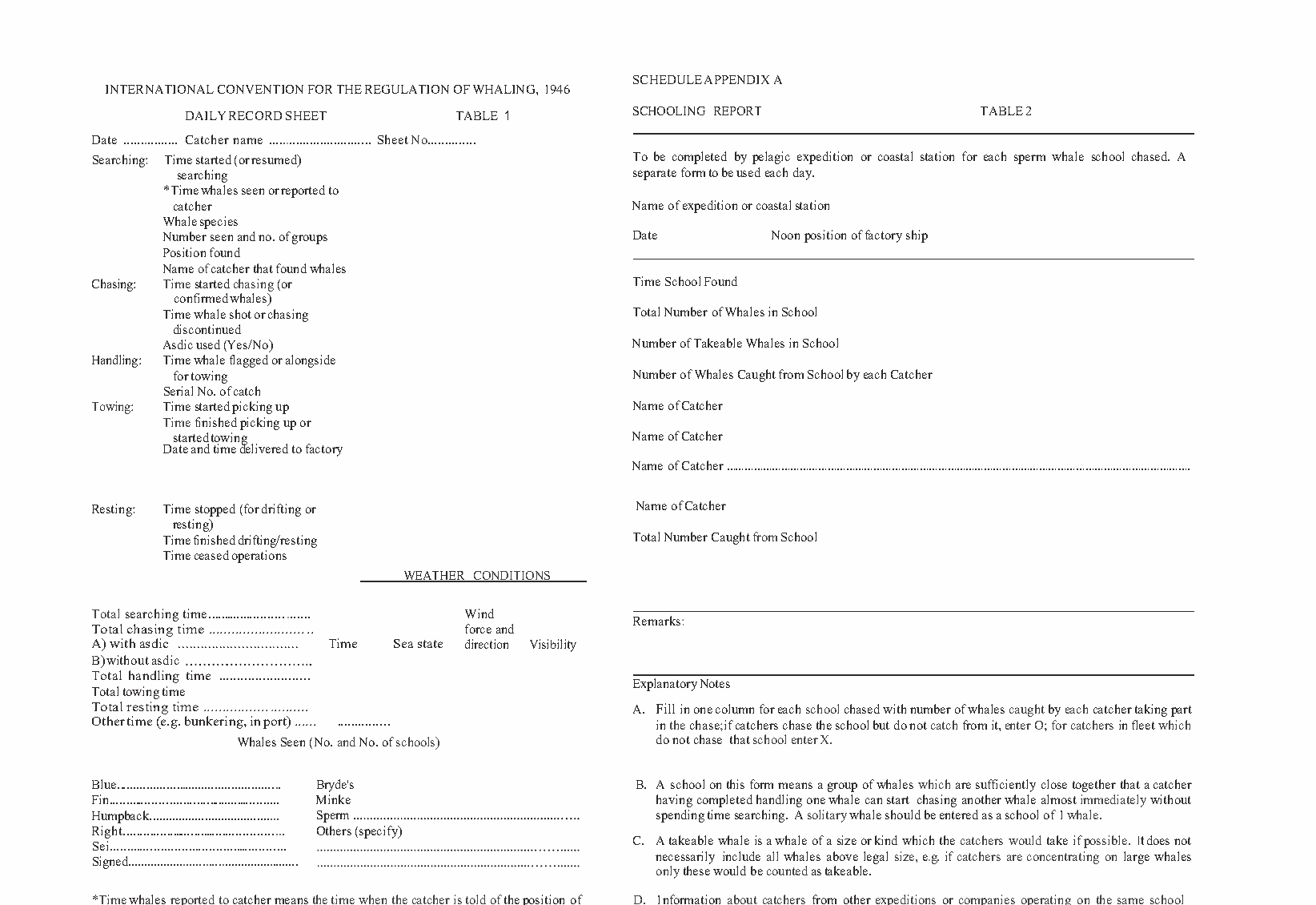
(ii) should also be recorded together with the following information, in the log book format shown in Appendix A, and forwarded to the Commission:
(1) where possible the time spent each day on different components of the catching operation,
(2) any modifications of the measures in paragraphs (a)(2)(i)-(iii) or (b)(1) or data from other suitable indicators of fishing effort for “small-type whaling” operations.
29. (a) Where possible all factory ships and land
(1) both ovaries or the combined weight of both testes,
(2) at least one ear plug, or one tooth (preferably first mandibular).
(b) Where possible similar collections to those described in sub-paragraph (a) of this paragraph shall be undertaken and reported by “small-type whaling” operations conducted from shore or by pelagic fleets.
(c) All specimens collected under sub-paragraphs
(a) and (b) shall be properly labelled with platform or other identification number of the whale and be appropriately preserved.
(d) Contracting Governments shall arrange for the analysis as soon as possible of the tissue samples and specimens collected under sub- paragraphs (a) and (b) and report to the Commission on the results of such analyses.
30. A Contracting Government shall provide the Secretary to the International Whaling Commission with proposed scientific permits before they are issued and in sufficient time to allow the Scientific Committee to review and comment on them. The proposed permits should specify:
(a) objectives of the research;
(b) number, sex, size and stock of the animals to be taken;
(c) opportunities for participation in the research by scientists of other nations; and
(d) possible effect on conservation of stock. Proposed permits shall be reviewed and commented on by the Scientific Committee at Annual Meetings when possible. When permits would be granted prior to the next Annual Meeting, the Secretary shall send the proposed permits to members of the Scientific Committee by mail for their comment and review. Preliminary results of any research resulting from the permits should be made available at the next Annual Meeting of the Scientific Committee.
31. A Contracting Government shall transmit to the Commission copies of all its official laws and regulations relating to whales and whaling and changes in such laws and regulations.
INTERNATIONAL CONVENTION FOR THE REGULATION OF WHALING, 1946
SCHEDULE APPENDIX A
TITLE PAGE
(one logbook per catcher per season)
Catcher name…………………………………………… Year built…………………………………………
Attached to expedition/land station .…………………………………………………………………………
Season…………………………………………………
Overall length…………………………………………… Wooden/steel hull………………………………
Gross tonnage……………………………………………
Type of engine..………………………………………… H.P. ………………………………………………
Maximum speed………………………………………… Average searching speed…………………………
Asdic set, make and model no.…………………………………………………………………………………
Date of installation………………………………………
Make and size of cannon………………………………………………………………………………………
Type of first harpoon used……………………………… Explosive/electric/non-explosive
Type of killer harpoon used……………………………………………………………………………………
Length and type of forerunner…………………………………………………………………………………
Type of whaleline………………………………………………………………………………………………
Height of barrel above sea level…………………………
Speedboat used, Yes/No
Name of Captain………………………………………………………………………………………………
Number of years experience……………………………
Name of gunner………………………………………………………………………………………………
Number of years experience……………………………
Number of crew…………………………………………
Schedule Appendix A. Logbook form